In the hustle and bustle of modern life, we often admire human achievements—soaring buildings that pierce the clouds, symbols of our ambition and intelligence. The Burj Khalifa in Dubai, standing at 828 meters, is a mesmerizing masterpiece of engineering. However, within each of us, hidden behind the cage of our ribs, lies a marvel that not only rivals but far surpasses such achievements. A machine that never stops, without command, working in total silence: the human heart. It does not build monuments of concrete and steel, but builds life itself, one drop of blood at a time.
Part 1: Anatomy of a Marvel – The Tireless Architect
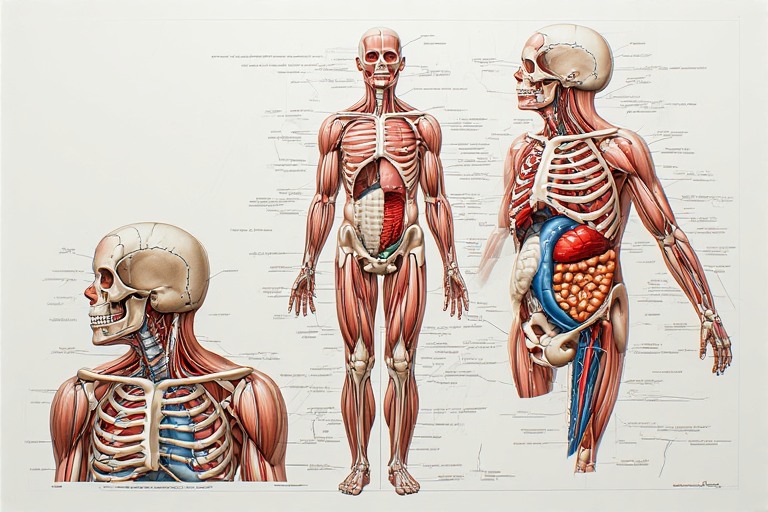
The heart is not merely a mechanical pump. It is a hollow muscular organ (myocardium) the size of a fist, designed with perfect precision. Divided into four chambers—the right and left atria, and the right and left ventricles—each with valves that function as one-way doors, preventing a deadly backflow.
Each heartbeat is an elegant cycle:
Relaxation (Diastole): The heart relaxes, receiving "dirty" blood (low in oxygen) from the entire body and "clean" blood (rich in oxygen) from the lungs.
Contraction (Systole): With coordinated force, the heart's chambers contract. The right ventricle pumps dirty blood to the lungs to pick up oxygen, while the left ventricle—the most powerful—pumps clean blood to every corner of the body, to the tips of the toes and the most remote cells in the brain.
This process, called one cardiac cycle, takes less than a second. Yet, within the simplicity of its mechanism lies astounding complexity.
Part 2: The Mathematics of Life – Calculating the Skyscraper in the Chest
Let us turn to numbers, the universal language of science, to appreciate its scale.
Average Resting Heart Rate: 70 beats per minute.
Volume per Pump (Stroke Volume): About 70 mL per beat.
Cardiac Output per Minute: 70 beats/min x 70 mL/beat = ± 4.9 liters per minute.
Now, imagine the average global human lifespan, about 73 years.
73 years = 73 years x 365 days x 24 hours x 60 minutes ≈ 38.4 million minutes.
Total Blood Volume Pumped: 4.9 liters/min x 38.4 million minutes ≈ 188 million liters.
The figure of 188 million liters might still be abstract. Let's convert it. One cubic meter (m³) is equivalent to 1,000 liters. Therefore, the total volume is 188,000 m³.
Part 3: Comparing the Incomparable: Heart vs. Burj Khalifa
The Burj Khalifa, the world's tallest building, has a total volume of approximately 1,120,000 m³. The volume of blood pumped by the heart in a lifetime (±188,000 m³) is equivalent to almost 1/6 (one-sixth) the volume of the Burj Khalifa.
Imagine: the entire space within that giant skyscraper—every office floor, every hotel suite, every nook and cranny—could be filled by the blood pumped by an organ weighing 300 grams from about 6 people over their lifetimes. This is a truly poignant comparison. The heart of a single human being alone is capable of filling a medium-sized skyscraper with its work.
Part 4: A Soothing Moral Message – A Reflection from Within
What can we glean from this astonishing scientific fact?
We are Walking Masterpieces. Each of us carries an unparalleled marvel of biological engineering. We often seek validation from the outside—from wealth, position, or the recognition of others—without realizing that the true miracle has been within us since birth. Cherish this body and this life, for it is a temple containing the most amazing machine in the universe.
Silent Perseverance and Loyalty. The heart never breaks down, never asks for a day off, never complains. It works in darkness and silence, for one purpose only: to ensure we stay alive. This is a powerful metaphor for dedication, responsibility, and performing our duties faithfully without needing the spotlight or praise.
Strength in Gentleness. The heart is a soft and fragile organ, protected by ribs. Yet, its strength is extraordinary. This teaches us that true strength is not always about hardness or rigidity. Compassion, love, and perseverance—like the gentle yet consistent heartbeat—are forces capable of building "skyscrapers" in our relationships and communities.
A Deep Connection with the Universe. The pumped blood carries oxygen from plants, nutrients from the earth, and connects every cell in the body into one cohesive web of life. We are not separate from nature; we are an intimate and dynamic part of it. A single drop of our blood is a reflection of nature's grander cycle.
Conclusion: Caring for the Grand Conductor
The symphony of our lives is conducted by an invisible conductor within our chests. Each beat is a song, each pump is a verse of poetry about survival. The fact that it can fill a skyscraper is not mere trivia, but a profound reminder of the capacity and potential we possess.
So, let us pause for a moment. Place a hand on your chest. Feel its steady beat. That is the sound of your personal skyscraper builder. That is the rhythm of the most personal and universal marvel. Honor it with a healthy life, a peaceful mind, and a grateful heart. For as long as this symphony continues, all other achievements—all the skyscrapers in the world—are possible
سَنُرِيهِمْ آيَاتِنَا فِي الْآفَاقِ وَفِي أَنْفُسِهِمْ حَتَّىٰ يَتَبَيَّنَ لَهُمْ أَنَّهُ الْحَقُّ ۗ أَوَلَمْ يَكْفِ بِرَبِّكَ أَنَّهُ عَلَىٰ كُلِّ شَيْءٍ شَهِيدٌ"
"We will show them Our signs in the horizons and within themselves until it becomes clear to them that it is the truth. But is it not sufficient concerning your Lord that He is, over all things, a Witness? (Q.S. Fussilat: 53)
By : Abu Sultan Al-Qadrie